
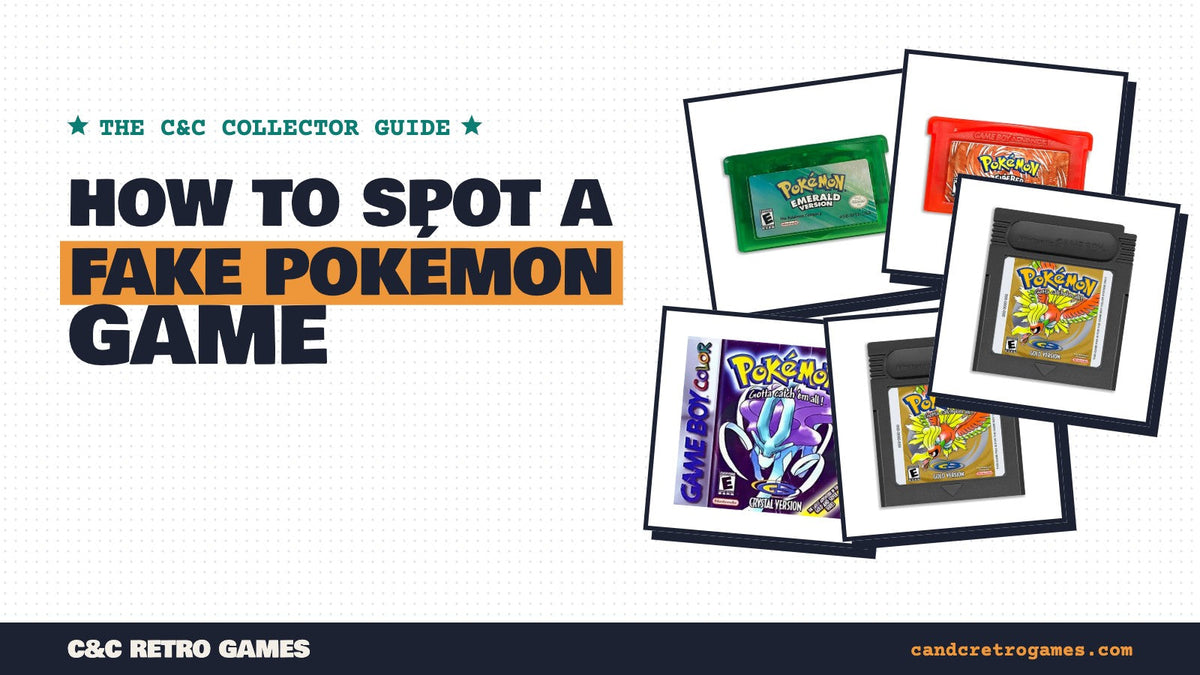
Pokémon games are the most faked games in retro gaming. Counterfeit copies of Emerald, FireRed, HeartGold and the Game Boy classics are everywhere online, and some look convincing at first glance. Fakes often lose saves, crash or fail to trade properly, so it's worth knowing what to look for. Here are the checks collectors use, from the quickest to the most thorough. No single check is proof on its own, so use several together.
Quick checks for any Pokémon game
- Price. If a sought-after game like Emerald or HeartGold is far below the usual price, be suspicious.
- Label print quality. Genuine labels have sharp artwork and text. Fakes are often blurry, too saturated, or slightly off in color.
- Missing details. Genuine labels include the game logo, the Nintendo logo, the Official Nintendo Seal, a rating symbol and a product code. A missing element is a red flag.
- Spelling and fonts. Misspellings, odd fonts or text that doesn't line up are common on fakes.
- Weight and feel. Fake shells often feel lighter, flimsier or rougher than genuine ones.
Game Boy and Game Boy Color
- Check the top of the shell. Genuine carts have "Nintendo" and "GAME BOY" molded into the plastic. A cart without the Nintendo name is fake.
- Check the shell color. Pokémon Gold should be gold, Silver should be silver and Crystal should be a clear blue. A Gold label on a gray or black shell is a giveaway.
- Check the region. A North American cart shouldn't mix in Japanese-style labels or shells.
- Save batteries. Many genuine Game Boy Pokémon games save using an internal battery, which can die after decades. A genuine cart that won't save may just need a new battery, so a save problem alone doesn't mean it's fake.
Game Boy Advance
- Look for the product code. Genuine labels show a code that starts with AGB and ends in the region, like USA. A North American cart shouldn't end in something unexpected.
- Look for the stamped number. Tilt a genuine label in the light and you'll see a small number pressed into it. Many fakes don't have one.
- Compare the label finish. Put it next to a photo of a verified real copy and compare the gloss, the colors and where the background artwork sits.
- Check the board. GBA carts open with a tri-wing screwdriver. Compare the circuit board to a photo of a verified genuine board. For example, Pokémon FireRed and LeafGreen don't use a battery, so a battery on their board means it's fake.
About the "internal battery has run dry" message
Genuine Ruby, Sapphire and Emerald carts have a small battery that runs the in-game clock. When it dies, the game shows a message saying the internal battery has run dry, and time-based events stop working. Your save still works, because those games save to a separate memory chip. The message on its own doesn't mean the game is fake.
Nintendo DS
- Match the front and back codes. The front label code starts with NTR or TWL and includes a four-letter product code and region, like USA. The code printed on the back should use the same product code. A mismatch means it's fake. The back code is printed in light ink and can wear off, so a missing one alone isn't proof.
- Check the label artwork. On genuine carts the background artwork and logos are crisp; on fakes they're often blurry.
- Hold black carts up to a light. On genuine black-shelled Pokémon DS games, the shell looks translucent purple in strong light.
- Check the DS menu. A genuine game shows its correct title and icon on the DS menu. A different or garbled title is a warning sign.
Test it by playing
If you can, play a few minutes, save, switch off the console and load the save. Fakes often lose saves, freeze at certain points, or fail when trading or transferring Pokémon to later games. A cart that passes the visual checks and saves reliably is very likely genuine.
Shop with a return policy
The safest way to buy is from a seller with a clear return policy and warranty. Every Pokémon game from C&C Retro Games comes with 30-day returns and our 180-day warranty, so if something isn't right, you're covered.
Shop genuine Pokémon games


Pokémon Ruby · $159.97
Shows a dry-battery message when its clock battery dies. That alone is normal.
Frequently asked questions
How can I tell if my Pokémon Emerald is fake?
Check for the AGB product code and a stamped number on the label, compare the label to a verified genuine copy, and test the save. A genuine Emerald shows the internal battery message only when its clock battery dies, and the save still works.
Do fake Pokémon games work?
Many fakes boot and play, but they often lose saves, freeze or fail when trading and transferring Pokémon. That's the main reason to avoid them.
What does "the internal battery has run dry" mean?
On genuine Ruby, Sapphire and Emerald, it means the clock battery has died. Clock-based events stop, but saving still works. The message doesn't mean the game is fake.
Why does my Pokémon Gold or Silver not save?
Genuine Game Boy Color Pokémon games save using an internal battery that can die after many years. A new battery usually fixes it, so a save problem alone doesn't mean the game is fake.
Which Pokémon games are faked the most?
The most commonly faked are the Game Boy Advance games (Emerald, FireRed, LeafGreen, Ruby and Sapphire), the Game Boy Color games, and the DS games, especially HeartGold and SoulSilver.
Every order is covered by our 180-day warranty, with 30-day returns and free US shipping on orders over $70.